
The Rumi Foundation
Relationship building is at the heart of ubuntu, which emphasizes the vital connections between individuals and community.

Relationship building is at the heart of ubuntu, which emphasizes the vital connections between individuals and community.

Abstract Prevailing scholarly analyses of international relations pay virtually no attention to music. And yet, the political dimensions of music are all too evident. The terrifying realities of conflict and the search for peace have inspired composers throughout history, from Joseph Haydn’s antiwar message in Missa in Tempore Belli to the astonishing outpouring of musical creativity following the terrorist attack of September 11, 2001. Few would question the political content of explicit musical texts, such as protest songs. The more difficult challenge, however, is to locate the significance not only of titles or sung passages, where references to the political are easy to find, but also of purely instrumental music. A number of important epistemological questions arise: How is listening different from smelling, touching, seeing, reading, rationalizing? What can we hear that we cannot see? And what is the political content of this difference? Expressed in other words, can we gain political insight through music that other sources of knowledge, such as texts or visual art, cannot provide? And if so, how can these forms of knowledge be translated back into language-based expression without losing the very essence of what they seek to capture and convey? Author: Roland Bleiker Read more at Springer Link.
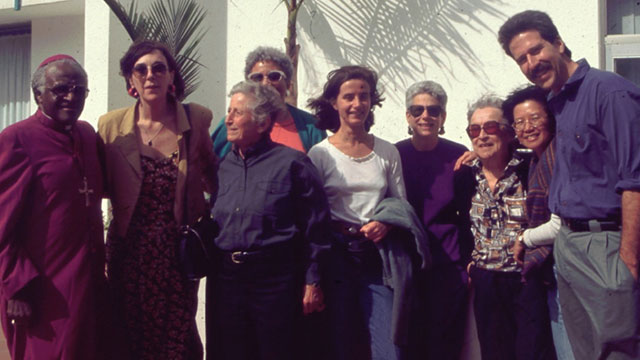
Archbishop Tutu taught me about ubuntu. With his passing, I am committing my core work to assist our move from the Age of Separation to the new Era of Ubuntu – a change that can minimize our divineness and make peace a reality. But what is this ubuntu – this “golden thread?” Clue: It’s not an operating system. The South African Interim Constitution and the statute that formed the Truth and Reconciliation Commission (TRC) said, “There is a need for understanding, but not for vengeance, a need for reparation, but not for retaliation, a need for ubuntu, but not for victimization.” Days before I participated in the first TRC hearings in 1996, I’d read in the Cape Times Tutu’s remark, “We are ready to forgive and build a new kind of country. This was only made possible by God’s special gift to South Africa, the gift of ubuntu.” I had never heard the term “ubuntu” until preparing for the hearings and was curious about a term characterized as God’s gift and included in their proposed progressive constitution. I needed to learn more. I’d scheduled a meeting with the Archbishop after breakfast in East London in order to record a greeting to lawyers and law students who wished to join our project as international monitors. We met in the back of the hotel restaurant with the crowd of diners buzzing in the background. His large gold cross clanged against the edge of the table. I’m nervous. Here is a man at the center of attention of the TRC and the world week taking time for me in his crowded schedule during this historic week. When we sat down I fired up the recorder and got down to business. “Archbishop, thanks for meeting with me. I wanted to record a greeting to monitors who may be thinking of coming to South Africa to observe this process—” At that point, he interrupts me by reaching across the table and placing his hand over mine. “Yes of course,” he says, smiling with his playful grin. “But first . . . Let’s say hi.” I’m blown back. In the haste to get him on to his busy day I’d not taken the time to connect, to meet as humans, or to even say hello properly. I was all business. What a gift he’s sharing in that simple moment, demonstrating that a genuine connection in any encounter, be it business or pleasure, is more rich when we take the time to honor and acknowledge each other: The power of saying “I see you” is immeasurable. I blush and say, “Hi,” and look deep into his eyes. He smiles and suddenly we’re just two grinning humans meeting on more equal ground. He records a beautiful comment for us to use in our outreach that spoke of the process and international solidarity, which included “Watch as this repulsive caterpillar becomes a gorgeous butterfly.” I could not have asked for more. But I have another question. “I have read
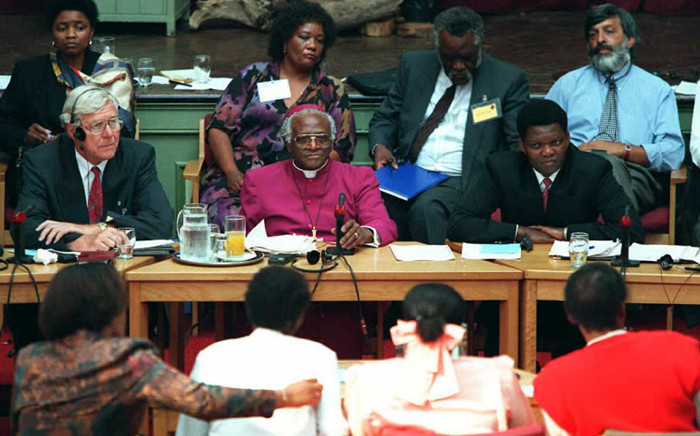
The South African Truth and Reconciliation Commission (TRC) is cited as a model around the world for healing the trauma of a nation or community. Yet, on my recent trip to South Africa a great topic of concern everywhere was the “unfinished” work of the TRC and how the populace was left disillusioned, as money has been siphoned off in sweetheart deals and the reparations side of the Truth Commission failed to deliver. I remember those hearings as if they were yesterday. I was there monitoring an International Project for the TRC and feeling so deeply the draining nature of the stories of gross human rights violations and atrocities. We wept with Archbishop Tutu in the first hearings in 1996 as he put his head down on the table and tears flowed like the blood from the attack that triggered his reaction. He wept for the whole nation and for all of us who feel a great disconnect from a world still fueled by war and violence. One night last month outside Cape Town my dear friends Ilze and Stef and I read poems to each other at a bar by the sea. Remarkably Ilze read: The Archbishop Chairs the First Session by South African poet, Ingrid de Kok The Truth and Reconciliation Commission. April, 1996. East London, South Africa On the first day after a few hours of testimony the Archbishop wept. He put his grey head on the long table of papers and protocols and he wept. The national and international cameramen filmed his weeping, his misted glasses, his sobbing shoulders, the call for a recess. It doesn’t matter what you thought of the Archbishop before or after, of the settlement, the commission, or what the anthropologists flying in from less studied crimes and sorrows said about the discourse, or how many doctorates, books, and installations followed, or even if you think this poem simplifies, lionizes romanticizes, mystifies. There was a long table, starched purple vestment and after a few hours of testimony, the Archbishop, chair of the commission, laid down his head, and wept. That’s how it began. Archbishop Tutu had told me on a break that day that he should not have lost his composure as the chair of the Commission, but it was a courageous and necessary human reaction to such torture. How we long for leaders who can not only point out problems, or offer packaged solutions, but can put down their heads, in the face of war, violence, or hunger, and weep. – – – – – Photos, Top: Archbishop Desmond Tutu (center) with fellow commissioners listen to testimony from witnesses during the start of the Truth and Reconciliation Commission which opened in East London, 15 April 1996, Picture-AFP. Bottom: Archbishop Tutu, TRC 1997 Sunday Times by Raymond-Preston

Most people see the legal arena as a place to do battle, a place where we annihilate the person we see as our opponent. We seek an attorney to be our warrior to win the legal battle for us. What if there was another way?

Surprised? Maybe not, but in this largest study in nearly a century, the reasons why might be surprising. “Understanding sex differences in empathy could help researchers better understand why certain mental health problems impact more men than women,” Jen Christensen, CNN writes. This latest study could also help scientists develop better support for people who may struggle to read facial expressions, the researchers said. “This study clearly demonstrates a largely consistent sex difference across countries, languages, and ages,” study co-author Carrie Allison, who is the director of applied research at the Autism Research Centre at Cambridge University, said in a news release. “This raises new questions for future research about the social and biological factors that may contribute to the observed on-average sex difference in cognitive empathy.” Click to read the entire article here. Review prior research here.